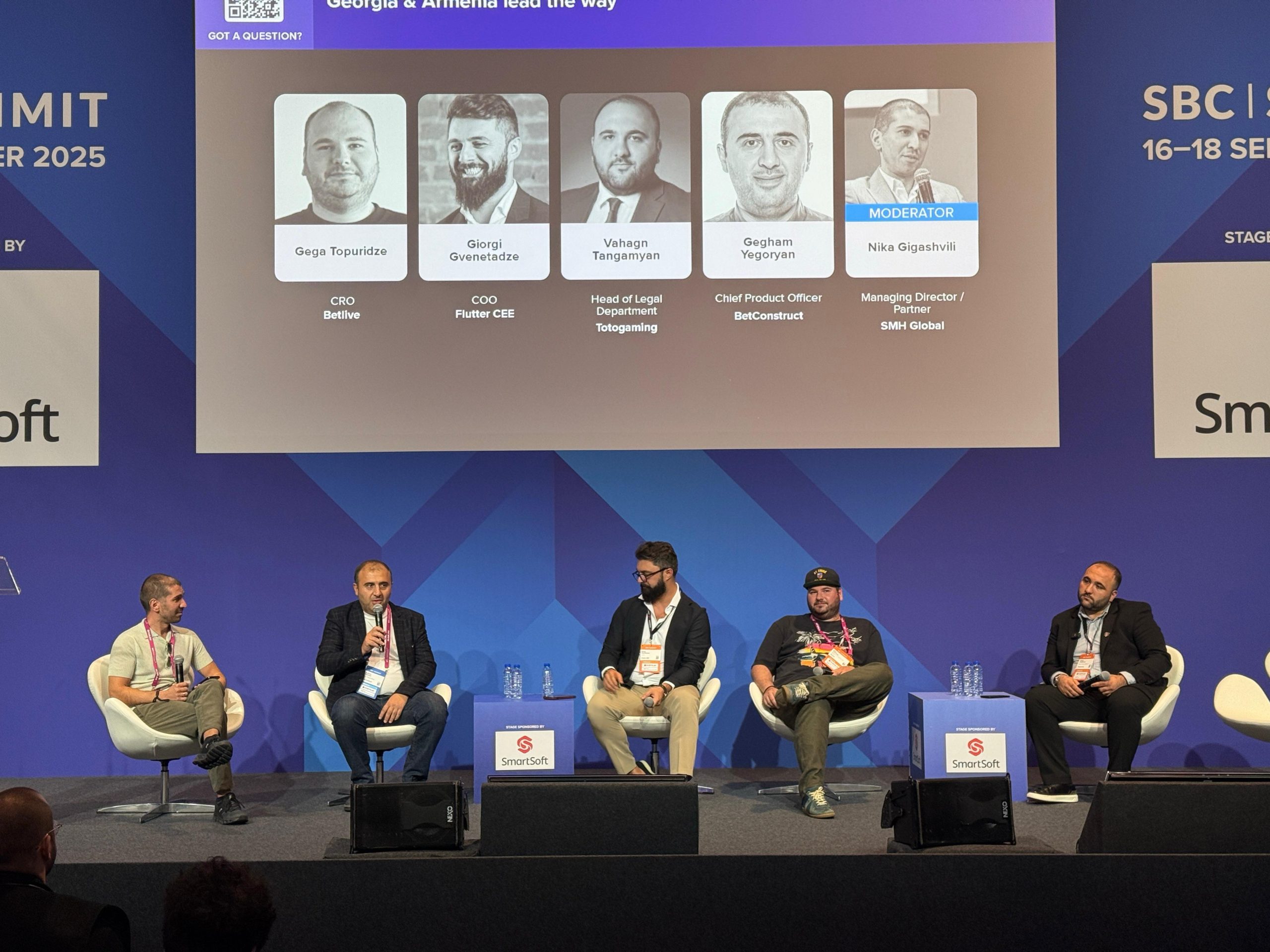
At the SBC Summit Lisbon 2025, a standout panel brought together industry leaders from Georgia and Armenia to discuss the region’s rapid rise as a hub for iGaming innovation and technology.
Moderated by Nika Gigashvili (SMH Global), the panel included Gega Topuridze (betlive), Giorgi Gvenetadze (Flutter CEE), Vahagn Tangamyan (Totogaming), and Gegham Yegoryan (BetConstruct). Their discussion revealed the unique strengths, challenges, and opportunities shaping the gaming landscape in these neighboring countries.
The session began on a lighthearted note, as the stage announcer broke the ice by jokingly naming the panel “Mimino” – a playful nod to the beloved Soviet film about Georgian-Armenian friendship and adventure. The reference set the tone for a discussion that would highlight not only the business ties but also the cultural connections between the two countries.
The panelists agreed that both countries have become magnets for tech talent. The numbers are impressive: “The market size is somewhere about 50,000 IT specialists in Armenia and 70,000 in Georgia. Considering that the population is close to 3 million in Armenia and 3.5 million in Georgia,” noted Gegham Yegoryan.
“Historically, the region itself has a reputation for being a center of excellence for product development for iGaming software.” This deep pool of talent, the panelists agreed, is a key reason why global operators are increasingly looking to the Caucasus for innovation.
But it’s not just about headcount. The region’s competitive spirit has fostered a culture of speed and adaptability. Giorgi Gvenetadze shared a telling anecdote: “With the Flutter brands, when we are seeing the US or UK operations, the teams are saying a project will take three to four months. Our teams say, ‘That’s a very complicated project, we might need a week for that.’ And they deliver.”
No discussion of iGaming in Georgia and Armenia would be complete without addressing the regulatory environment – often described as both a challenge and a catalyst for innovation.
“In Armenia, the gaming industry is under the state’s attention, not only attention, but also under pressure,” said Tangamyan. “In a single year, we do a lot of legislative changes… The latest one is taxation.” He explained that while B2B regulations remain relatively friendly, B2C operators face a more complex and evolving landscape.
Georgia’s experience has been similar, according to Gega Topuridze. “There have been some hard times… But business was always prevailing. As long as the business is legal and regulated, it makes us think faster and more creatively,” he said. “Retention became the key because of the regulations, and the technology side plays a huge part.”
Despite the challenges, there are signs of progress. “We are being introduced to the new regulations or the changes almost every year,” said Gvenetadze. “But the good point here is that [regulators] are more or less starting to be ready and open for the talks and the negotiations.”
The panelists were unanimous in their message: Georgia and Armenia are open for business, and the time is ripe for international expansion. “The fact that Flutter CEE is now headquartered in Georgia speaks for itself that the country is ready to be the regional hub for various things – market expansions or talent mobilizations,” said Gvenetadze.
Yegoryan emphasized that success in the region requires more than just technical know-how. “When you are going to the market, you need two things: talent and domain knowledge. How you feel about the business, how you know the product, and so on. If you have success here, then you will have success in almost all regions.”
For international operators, the regulatory environment can even offer advantages. “With the new regulation, you can create a new domain for a new country and just run operations without establishing in the country where you are running operations,” explained Topuridze. “For online gaming, 20% GGR from Georgian players, 5% GGR from foreign players; for sports betting: 7%.”
As the session drew to a close, the panelists offered advice for companies considering a move into the region. “If you can make it here, you can make it anywhere,” said Topuridze, echoing the sentiment that Georgia and Armenia are proving grounds for global success.
Don’t forget to subscribe to our Telegram channel!