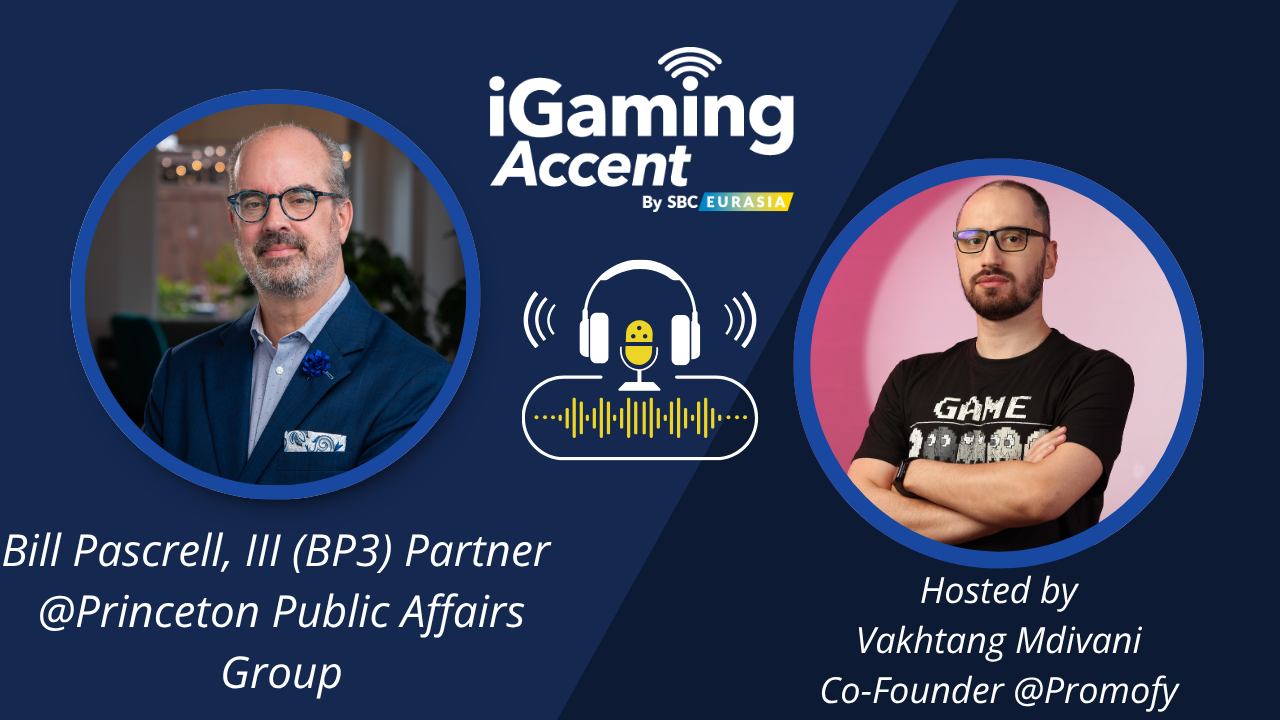
In the latest episode of iGaming Accent, host Vakho Mdivani sits down with Bill Pascrell III, a lawyer and lobbyist with over three decades of experience in gaming regulation. The conversation covers his remarkable career journey, the evolution of American iGaming, and the seismic disruption that prediction markets are causing across the entire industry.
Bill opens by sketching a career path shaped by political legacy and personal conviction. Growing up in a household defined by public service – his father was a congressman for 30 years – he went through Harvard’s Kennedy School of Government, Seton Hall Law School, and government service before entering the private sector. A pivotal moment came in October 2009, when a decade-long campaign was launched that ultimately led to the legalization of iGaming in New Jersey on November 23, 2013, and the repeal of PASPA – the federal ban on sports betting – by the U.S. Supreme Court on May 14, 2018.
Bill is unequivocal in his belief that licensed, regulated operators are the good guys of the industry – and that the sector has been too timid in saying so: “Everybody in the world of gaming – licensed, regulated, tax-paying, job-creating – should be proud of themselves. We are the good guys. But the industry seems to be too scared to come out of a cocoon.”
He draws a sharp contrast with black market operators: “The black market doesn’t protect the consumer. They have money laundering. They don’t care about taxes.”
The heart of the episode, however, is Bill’s candid and deeply informed take on prediction markets – arguably the most consequential disruption facing the American gaming industry today. Platforms like Kalshi, Polymarket, and Robinhood have emerged as a powerful new force.
He explains the fundamental structural difference between traditional sports betting and prediction markets in plain terms: “When you bet on a sport, you put up a dollar, you’re betting against the house with the odds. In predictive markets, it’s very different. It’s what I call a binary option – a yes or no option, like the stock exchange.”
In Kalshi’s model, the operator doesn’t pay out winnings – the person on the other side of the bet does. “Kalshi takes what we call a small rake. Very small. It’s pennies.” The product also extends far beyond sport: users can bet on the Academy Awards, the weather, politics, and more, creating a vastly broader engagement surface than traditional sportsbooks.
The numbers are staggering. Kalshi, operating for fewer than 20 months on a commercial scale, is already valued at $22 billion – larger than Flutter Entertainment. Prediction markets are currently permissible in virtually every US state except Nevada, where an injunction is in place. Meanwhile, operators in states without legal sports betting – including Texas and California – are already using these platforms.
“They’re making monster money,” says Bill. And the political backdrop is impossible to ignore: “The President of the United States is loyal to very few people, but he’s for sure loyal to his children. His son, Donald Trump Jr., is on the board of Kalshi.”
Bill is clear-eyed about what this means for traditional operators who were slow to act: “FanDuel, DraftKings, and Caesars left the American Gaming Association last fall. That was the beginning of the end. They left and started their own predictive markets. If you’re an operator and you’re not looking at predictive markets, you’re gonna fail.”
He draws a sharp historical parallel: “The NFL was opposed to sports betting, and look what happened. They lost.”
His proposed solution is a pragmatic peace accord between the two sides: let the federal government provide an umbrella regulatory framework, let state governments tax it and retain a certification role.
He also responded to a question from Kaido Ulejev, an industry veteran and former Commercial Director at CEECA Betsson, and posed one of his own for the next guest.
To hear the whole conversation and gain even deeper insights, listen to the complete podcast episode of iGaming Accent.
Don’t forget to subscribe to our Telegram channel!