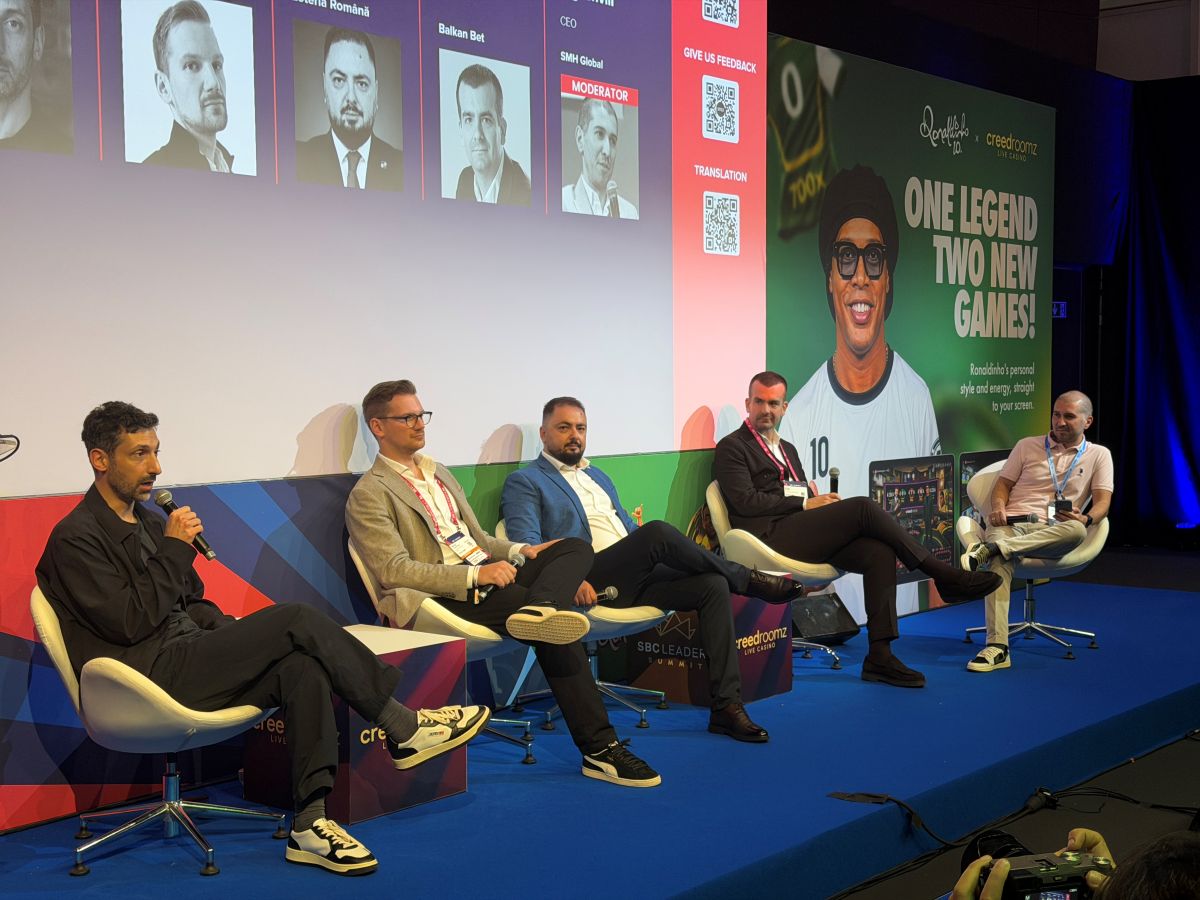
At SBC Summit Lisbon 2026, executives from Balkan Bet, Loteria Română, Entain CEE and Flutter CEE discussed why expansion across Central and Eastern Europe requires more than a strong product and investment capital.
Central and Eastern Europe continues to offer opportunities for gambling operators. Regulatory predictability, strong local competitors and the relationship between retail and online operations are shaping where – and how – companies can grow.
These themes underpinned “CEE in Transition: From Established Giants to Emerging Opportunities”, moderated by Nika Gigashvili of SMH Global, with Bojan Scekic of Balkan Bet, Ionut-Valeriu Andrei of Loteria Română, Mikolaj Cymerman of Entain CEE and Irakli Asanishvili of Flutter CEE.
Stability before scale
Asanishvili put regulatory transparency and predictability among the most important considerations when assessing a market. But he also challenged operators to look inward before committing to expansion.
“Are we ready to win there?” he asked.
Scekic emphasized stability, noting how closely gambling regulation is tied to politics. He saw room for investment over the next three to five years, but was cautious about finding exceptional, rapidly emerging markets.
Andrei brought that uncertainty down to an operational level. He said Romania’s shift from central authorisation to local licensing had created a substantial burden for Loteria Română, with its more than 2,000 physical points of sale.
“That means we would have to obtain a licence in 2,000 places. Two thousand mayors with two thousand perspectives, with two thousand political issues. And this is not just an issue for the lottery; it is an issue for all operators in Romania,” he said.
The example illustrated why the details of regulation can matter as much as whether a market is formally open.
Cymerman nevertheless identified potential opportunities: Poland’s online casino segment, should it open beyond the existing monopoly, and possible developments in Hungary and Albania. His enthusiasm came with a qualification. CEE’s established operators, many of which built their brands through retail before moving online, are difficult to displace.
“The barrier for entry for any kind of newcomers is very hard,” he said.
The retail question
The debate over physical presence revealed why a strategy that works in one CEE market may struggle in another.
For Scekic, retail remains a way to build customer relationships and reinforce a brand—not merely a network for handling cash.
“It’s not just cash-related. It’s more brand-related,” he said.
Cymerman contrasted Poland, where he said heavily funded online newcomers had succeeded, with Balkan markets, where physical outlets remain important for deposits and withdrawals.
Asanishvili offered a different perspective: retail’s importance does not mean customer habits are fixed. A more convenient digital experience can change behaviour, provided it addresses the trust and payment needs traditionally served by shops.
“If you can solve these two problems without retail, then I don’t see why you can’t build business without having a heavy retail presence,” he said.
Andrei’s account suggested that the two channels need not compete at all. Loteria Română initially expected online ticket sales to represent around 15% of sales, he said. After two years, the share exceeded 50%, while retail also grew.
“We were very nervous about killing the retail. But in fact, what we realised was that the retail grew as well.”
Why “copy-paste” fails
If the speakers differed on how much retail an operator needs, they were aligned on the importance of localisation.
Cymerman pointed to sporting preferences – ski jumping and speedway in Poland, water polo in Croatia – as examples of differences that reach far beyond language. Casino content, CRM and marketing also require local understanding.
“I’m very much against this kind of approach of … copy-paste, copy-paste just to put a pin in the map,” he said. “It just doesn’t work.”
Scekic argued for combining that local knowledge with group-level technology and commercial expertise. Asanishvili briefly summed up his understanding of what should and shouldn’t be localised: “Customer-facing local, enterprise global.”
Advertising restrictions add another layer to the equation. Scekic said limited opportunities to build brand awareness can favour acquiring an established operator over launching from scratch. Andrei defended moderate advertising as a way to help customers identify legal businesses, while Cymerman warned that restrictions on licensed operators must be considered alongside competition from the unlicensed market.
Cymerman also called for restraint within the industry itself: “There is an element of self-regulation that we need to put on ourselves.”
For companies plotting their next CEE move, the discussion offered a practical conclusion: a place on the market map is not a strategy. Sustainable growth requires confidence in the rules, a clear reason for customers to choose the product, and the local expertise to deliver it.
Don’t forget to subscribe to our Telegram channel!