In June 2026, 1xCare announced itself to the industry, promising to contribute to debates on player protection across the global sector. The body stated it would use research, education, technology and player well-being to become an international hub for responsible gambling excellence and best practice.
Importantly, though, it stated it would contribute to the debate, not complete it. The body carefully assembled an advisory board chaired by Simon Westbury, with global, holistic industry expertise.
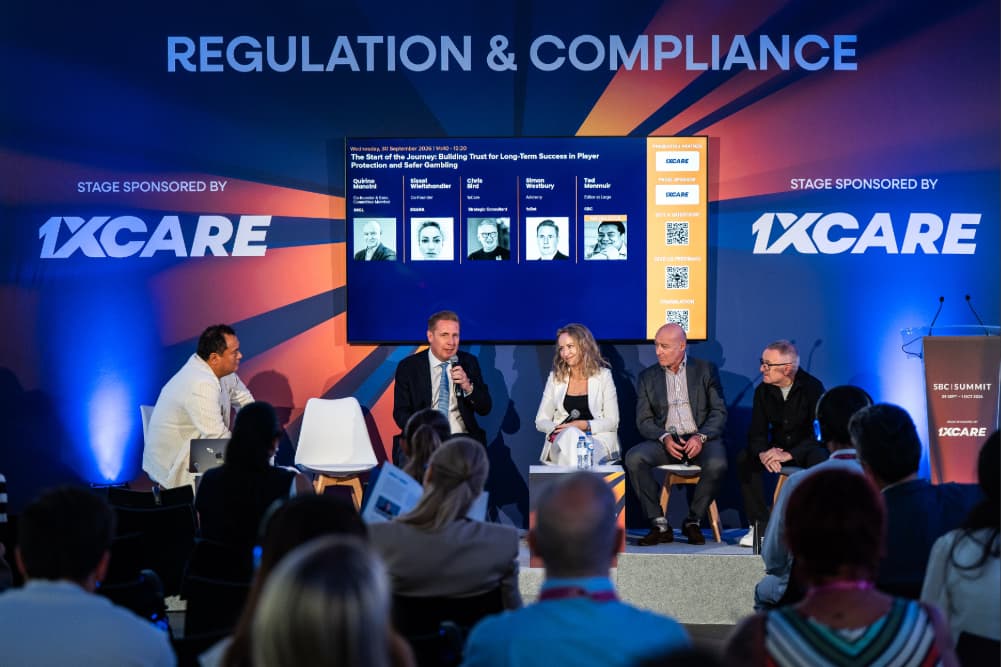
At SBC Summit 2026, the advisory board appeared to share some early findings and discuss its wider aims and objectives.
Westbury said that while 1xCare was an organic idea that emerged from meetings at 1xBet’s offices in Cyprus, it operates independently and is registered under a separate company. The advisory board autonomously makes decisions on funding, not the operator.
“The actual rationale for 1xCare is to make a positive impact in a verifiable way across the industry,” he noted.
The advisory board features:
- Chris Bird, former COO of Manchester City FC and CEO of the Raheem Sterling Foundation, who brings expertise from the sports and media industries.
- Quirino Mancini, Co-Founder and former President of International Masters of Gaming Law (IMGL) and legal advisor for over 20 years in iGaming.
- Sissel Weitzhandler, former Director of Compliance and Regulatory Affairs at Allwyn and global compliance specialist, Co-Founder of EGARA (Executive Gaming and Risk Advisory), Member of IMGL (International Masters of Gaming Law).
Each member brings specialist skills to help 1xCare achieve its aims to contribute to research, education, technology, and wellbeing, its four key pillars of player protection.
“The one thing that Simon put to me when we first spoke was the passion around education,” Bird explained. “That got me because everything that I do within my consultancy is around education for young people and people in sport, whether that’s the players on the pitch, the staff in the background, or the fans on the terrace, or on the screen.”
One of the core goals for 1xCare is to contribute towards and create dialogue between all industry stakeholders: operators, regulators, suppliers, players and governments. Greater alignment and consistency on regulatory requirements for player protection are needed to ensure operators meet their obligations on a level playing field.
Mancini has noticed this throughout his career, which began in the mid-2000s and is still ongoing, by advising and accompanying several international operators through the most delicate and challenging transition from the ‘.com’ world to a fully regulated market like Italy.
Those who hitherto used to be called the “bad guys”, he noted, were amongst the first operators to apply for a locally granted online gambling licence with the attached heavy package of regulatory compliance that they accepted to fully abide by.
“After so many years in the making, I believe all the big international operators have come to realise and acknowledge that getting a local licence and playing by the book is the most sensible and right (if only) way forward. Indeed, gambling services are potentially dangerous as they can be addictive and trigger unnecessary problems, short of the big reputational issue attached to this industry.
“Accordingly, the only way for the global industry to safely, sustainably and compliantly address what objectively remains a rather popular, widespread and historic demand for gambling services, is to do so under the scope of a clear and consistent set of rules that can better protect consumers in general and minors and other vulnerable in particular.”
Weitzhandler explained that today, with many markets undergoing rapid regulatory changes and sudden advertising bans taking effect, there is real fallout. Ultimately, she noted, players will be forced into the black market because licensed operators will not be able to compete.
“Regulation only protects the players it can reach. We therefore need to make sure that we have open licensing regimes and regulations that can achieve the objective of protecting players. This requires an adaptable, evidence-led and pragmatic approach, because, as we can see time and time again, the less appropriate, flexible or pragmatic rules are, the higher the likelihood will be that players move outside the licensed market to gamble.”
Nowhere has this force been felt more strongly than in Brazil, where President Lula issued an order to ban online gambling entirely just two years after the regulated market opened and international businesses invested millions of dollars in the country.
Mancini labeled Lula’s move as ‘ill-judged’ and ‘entirely poll-driven ’, explaining that prohibiting online gambling literally from one day to another after having legalised the local market only just a few years ago, ‘you are not going to kill the chicken with all the eggs’. He recalled that the Italian government abruptly banned advertising in 2018 and said the challenges there mirror what is happening in Brazil today.
“My conclusion is this: prohibiting flat-out is always wrong,” especially if such a draconian approach is not preceded and fully supported by independent research, objective data and a fair stakeholder consultation process, he said.
“In my view, the right recipe is to implement rules that are deliverable, sustainable and reasonable. This can only happen if there is an open dialogue between all the stakeholders: the providers, the operators, the regulators, the consumer associations and, in one ideal future day, the policymakers, who most often are the real troublemakers as they know very little (if anything at all) about the gambling business, are quite biased and solely driven by political considerations aimed at gaining more electoral consensus.”
How the Industry Can Rebuild Public Trust
Westbury, meanwhile, was candid that events such as Lula’s betting ban in Brazil, along with tax hikes and stringent regulation in other jurisdictions, reflect the industry’s loss of trust with governments and the public. Until that changes, he warned, similar measures will be introduced elsewhere, which is why 1xCare’s mission is so critical.
“It’s symptomatic of the journey this industry’s been on for a very long time,” he noted. “We’ve lost our licence to engage with society. When you lose that license, you lose the opportunity to actually engage and build trust.
“Banning gambling doesn’t work, but actually creating regulatory environments which are not actually commercially viable for operators is also a challenge, and it all comes back to the fact that we as an industry have lost our license with society.”
1xCare exists to help change those attitudes. Through research, education, technology, and wellbeing services it funds and commissions, it hopes to engage different layers of society to improve player protection.
Weitzhandler noted that the advisory board also has a major responsibility to ensure research independence and that those who receive funding can deliver healthy, actionable insights to the debate.
“Building in the governance structures from the beginning in 1xCare is one of the things that we are trying to do,” she explained. “We want to make sure that we work towards an evidence-based approach, to ensure that we publish the results, even when they might not be in the favour of operators.
“It needs to be in favour of the overall discussion and we must be transparent with everything we do.”
However, one organisation can only do so much alone. 1xCare is committed to funding research, education and wellbeing services, but there needs to be organisations willing to conduct those activities.
Crucially, industry needs to be willing to engage with the debate and act on some of the findings from the body of work.
For Bird, communications and engagement is the first critical step to creating a holistic player protection programme.
He said: “Without the dialogue, and without the trust building, and the education, and the four pillars that we’re talking about, (we can’t) solve those communication issues. I think what 1xCare can do is to present a body of work and a way of working to the industry to say, “Here’s a good way of actually making sure that the end user is understanding everything that we do.”
Mancini echoed those sentiments, adding that industry needs to engage with regulators and governments. Ultimately, everyone should work together toward a common goal.
“It is essential that we will all start converging towards the same endpoint, which is working in an environment that actually is governed by a set of clear rules that are complied with and by all players and operators that are involved in that.”
Finally, Westbury warned the wider industry. He said player protection needs to be built into products and services from the ground up. Operators have a massive responsibility for player protection, and so does the whole supply chain.
“We need to move past performative compliance,” he asserted. “We actually have to ingrain player protection and safer gambling tools from the conception of products, because people forget that operators buy products. We may have a platform, but we’re buying products, so we need to actually commit as an industry to put these tools in from the conception of the product to the delivery to the end user.”
Don’t forget to subscribe to our Telegram channel!