

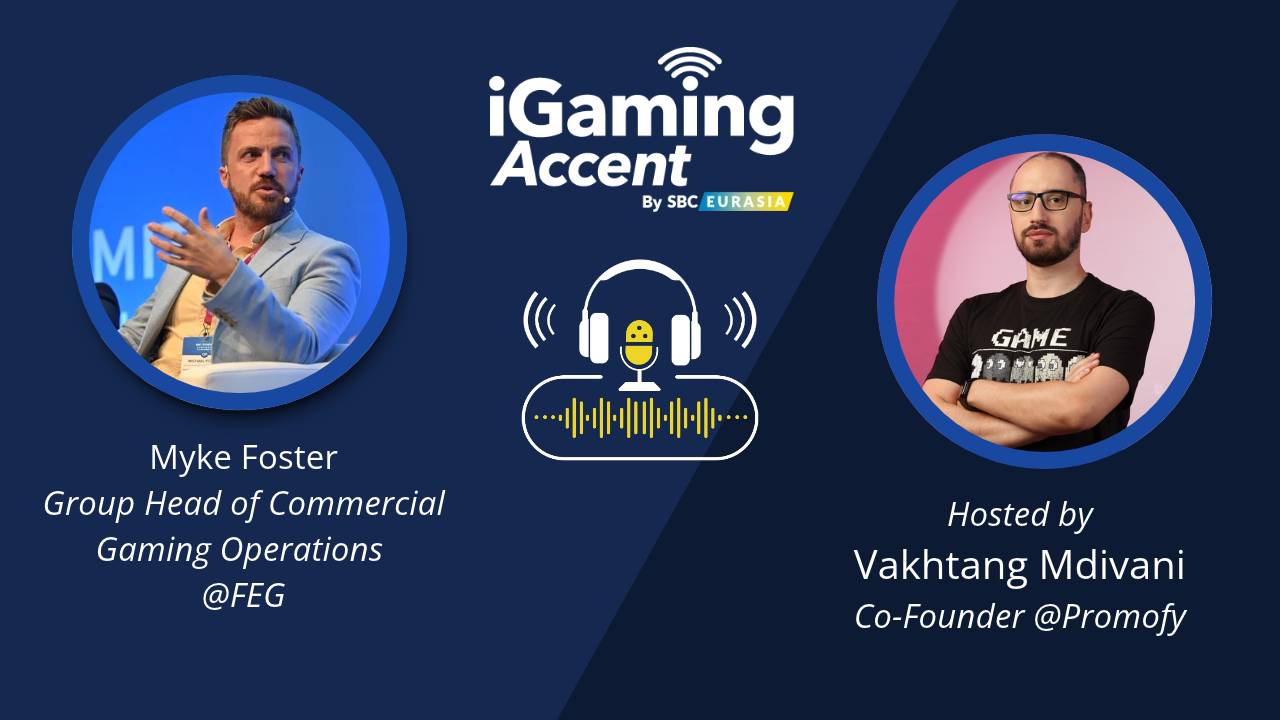
In the latest episode of iGaming Accent, host Vakho Mdivani welcomes Myke Foster, Group Head of Commercial Gaming Operations at Fortuna Entertainment Group (FEG), for a conversation about running casino across multiple regulated markets – supplier relationships, exclusive content, the limits of centralised product thinking, and why the unregulated market often delivers a better experience than the licensed one.
Myke’s entry into the industry was accidental: fresh off an MBA, he walked into a William Hill shop and started as a shop assistant two days later. That six-month gap-filler is now approaching fifteen years, spanning UK retail operations, Gibraltar, BetVictor, and GVC, before a formative Head of Sportsbook role at Ladbrokes.
The move to Prague brought the biggest professional pivot of all: a sportsbook man handed casino. “Globally, casino’s the growth engine of our industry, and I couldn’t say no.”
Asked what was hardest about the switch, Myke answers without hesitation: the supplier relationships. In a sportsbook, you have a handful of feeds and services – “you don’t have a day-to-day relationship necessarily with these people, because it’s a supplied service.” Casino is a different order of magnitude: “Across the group, I think we have 73 different suppliers at the moment. My sensible head says, ‘We don’t need 73 suppliers’… we need five or six great ones. But customers have different wants, different needs, and different favourite content.”
The other structural difference he highlights is rhythm. Sport comes with a built-in schedule: “If Man United are playing at 3:00 PM on a Saturday, that’s the customer’s appointment to view. I know what my customer traffic is. I know when they’re coming.”
Casino has none of that – “it’s a genuine 24/7 product, and creating journeys and experiences and propositions around that is a lot tougher.”
On culture, Myke is candid that Prague is not Malta or Gibraltar, and that this cuts both ways. FEG lacks the economy of scale that comes with a single working language – “every one of our countries has a different primary language” – and it cannot draw on a dense local pool of industry veterans. But the flip side, he argues, is a genuine advantage: “You can certainly get stuck in this ecosystem of doing the same thing over and over in gaming. Bringing people in from genuinely different industries… their cultural approach, their approach to business, their approach to customer is totally different than what you would have had if our office was in Gibraltar and we were full of people who had been in the gambling industry for 20 years.”
He is realistic about the ceiling regulation places: “We are rarely the first to market with content, because of the nature of the regulation and the sign-off process and certification in our markets.” Synchronised multi-market launches are effectively off the table – “it’s genuinely not really possible” – because studios available in Czechia often are not licensed in Croatia, Romania or Lithuania.
FEG’s answer has been to use its regulatory relationships as leverage for everyone: “We’ve done a lot of positive work by actually helping a lot of the suppliers get their content into markets because of the relationships that we have with the ministries or the regulators. And we’ve seen the commercial benefits of that.”
The most disarming passage of the episode concerns the limits of his own judgment. “I have never been wrong so often as I have since moving here, to Central and Eastern Europe. What works in North America, what works in the UK and Western Europe, is absolutely not what works in Central and Eastern Europe.”
He offers a concrete example: an animal-themed title launched in Czechia that he wrote off on sight: “I thought, ‘Absolutely not. This is gonna die on the vine.’ One of the games was the most successful launch we’ve ever had”.
The lesson he draws is about who gets to decide. FEG has a head of gaming and a casino product owner in every market, and he leans on them deliberately: “Their local expertise is totally invaluable. They don’t only know the customer; they are that customer themselves.” He adds, with some warmth: “I’m often humbled, and it’s actually quite satisfying to be humbled, because it means you’re working surrounded by people that know more than you do.”
Looking ahead, Myke is unusually blunt about the competitive reality facing licensed operators. FEG works exclusively in regulated markets – “a choice that we’ve made, and it’s something that we stand by, and we’re very proud of” – but he refuses to pretend that this is costless.
“In your customer’s mind, if you are a customer, the gray and unregulated market doesn’t exist. A product either works or it doesn’t. To be completely honest with you, the experience of many unregulated or black market casinos is significantly better than the regulated market, because they’re not jumping through a lot of the hoops that we’re jumping through.”
His hope is that the next few years belong to the regulated sector, but only if enforcement catches up: “You really have to either block the flow of content or block the flow of money in order to re-regulate some of these industries. We need more consistent regulation across Europe, and we need more clarity over why regulations are changing.”
Myke also answered a question from Mikolaj Cymerman, Chief Commercial Officer at Entain CEE, and posed one of his own to the next guest.
To hear the full conversation and gain deeper insights, listen to the complete iGaming Accent podcast episode.
Don’t forget to subscribe to our Telegram channel!


