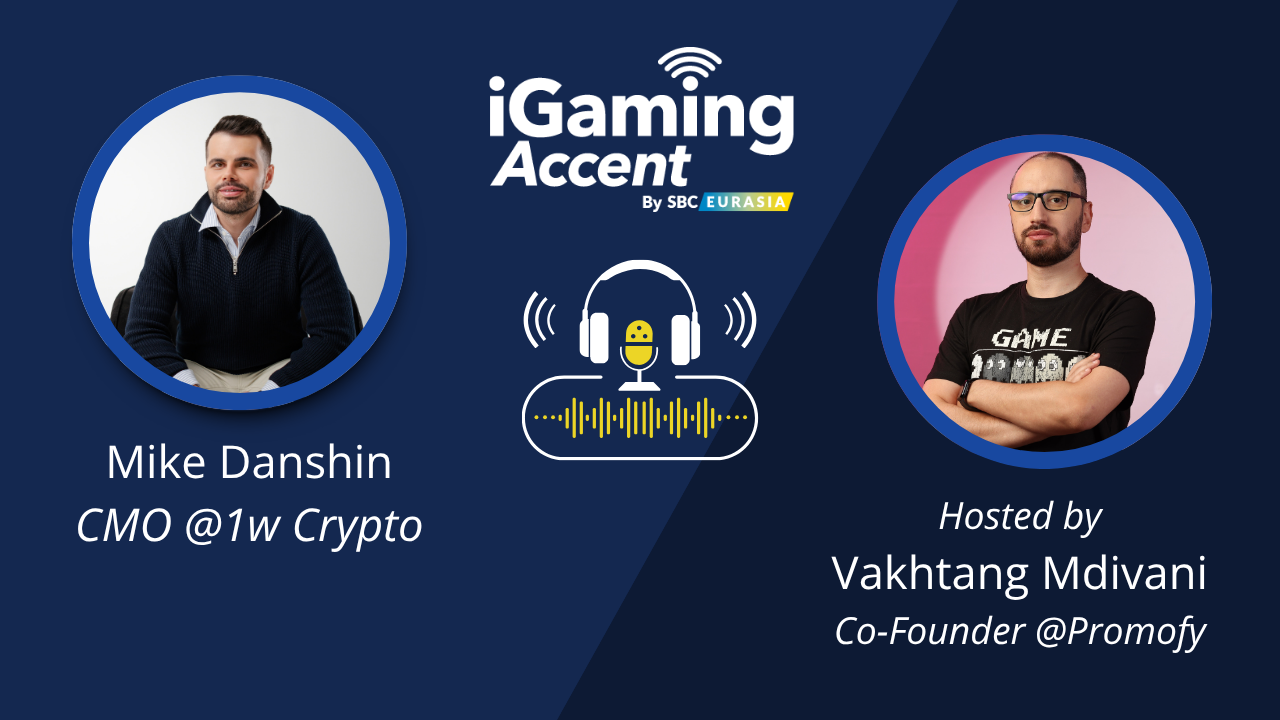
In a new episode of the iGaming Accent podcast, host Vakho Mdivani welcomes Mike Danshin, Chief Marketing Officer at 1w Crypto, for a wide-ranging and candid conversation about the realities of crypto gaming, the differences between Web2 and Web3 marketing, and the future of player acquisition in an increasingly complex digital landscape.
Mike introduces himself and his role: “I’m Chief Marketing Officer at 1w Crypto. I’m in charge of the full stack of crypto marketing communications, starting with acquisition, such as crypto campaigns and then social media, then special crypto networks such as Brave, CoinZilla, Blockchain Ads, and so on.”
With operations spanning 20-plus geographies and key markets in South Korea, Latin America, and India, Mike’s experience is as broad as it is deep. He has spent nearly a decade in iGaming, starting with a social casino called Betting Insider at a time when the very concept of social casino was still new: “There was no such term as social casino or social betting, and we were doing some things that were really new for the industry, and nobody really had a playbook for such things.”
From there, his career took him through sports betting, land-based casinos, traditional gambling, and ultimately into crypto.
When asked about his shift from Web2 to Web3, Mike is direct: “I realized that Web2 iGaming is very slow. Lots of approvals, long implementation cycles, and innovation moves really slowly. And crypto is the opposite. It’s very speedy, few barriers, and when you get a taste of that pace, going back to the traditional Web2 industry, I believe it’s not an option.”
He estimates the difference between crypto and traditional iGaming marketing at around 20-25%, with the main distinctions lying in channel mix and speed. While traditional gaming relies on Facebook, Google, and large affiliates, crypto marketing relies on Telegram, Twitter, Discord, and crypto-native ad networks. Crucially, his team is structured not by geography but by channel – a deliberate choice born from experience:
“We tried to structure our department by geos or by big regions, but soon we realized that there are practically no guys in our industry who can run campaigns on Facebook, then do good quality affiliate marketing, and work with Twitter and Discord as well.”
On the question of acquisition versus retention, Mike offers one of the episode’s most thought-provoking insights. He believes that AI will soon render traditional media buying obsolete: “I believe that one day, and I believe that will be very soon, that artificial intelligence agents will kill the traditional media buying, because classic player acquisition is quite mechanical.”
Instead, he argues that the real opportunity in crypto lies in building ecosystems – combining a casino with a token, token staking, NFTs, and holder utilities – so that a single user can have multiple relationships with the brand: “One user can be a player, a token holder, and an NFT holder or NFT staker.”
This multi-layered approach, he says, is what separates sustainable crypto businesses from those chasing short-term hype.
Mike is equally candid about the pitfalls of hype-driven strategies. Referencing a well-known competitor that recently shut down despite an innovative product and a strong launch, he warns: “Six months after the token pump, nobody will play at your product without proper marketing, without proper community building.”
He is equally skeptical of high-RTP strategies used as acquisition tools: “If you don’t understand what your traffic channels actually deliver in terms of quality, you will just run away with your money… The most difficult thing in iGaming, I believe, is to fix the broken economy.”
For Mike, retention is the north star: “Retention is the most important metric for me, not FTD and not even lifetime value, because it shows you the long-term process.”
Community building, he explains, plays a vital supporting role — not as a replacement for paid channels, but as a way to lower acquisition costs over time and build genuine loyalty: “Community works when people have reasons to stay beyond one deposit. Players with history want to establish relationships with your brand.”
Mike also shares practical advice for aspiring CMOs and founders entering the crypto casino space, reflections on the World Cup, the challenges of working in uncertainty, and the importance of building clean analytics infrastructure.
He also responded to a question from TotoGaming’s Tereza Tokmajyan and posed one of his own for the next guest.
To hear the whole conversation and gain even deeper insights, listen to the complete podcast episode of iGaming Accent.
Don’t forget to subscribe to our Telegram channel!