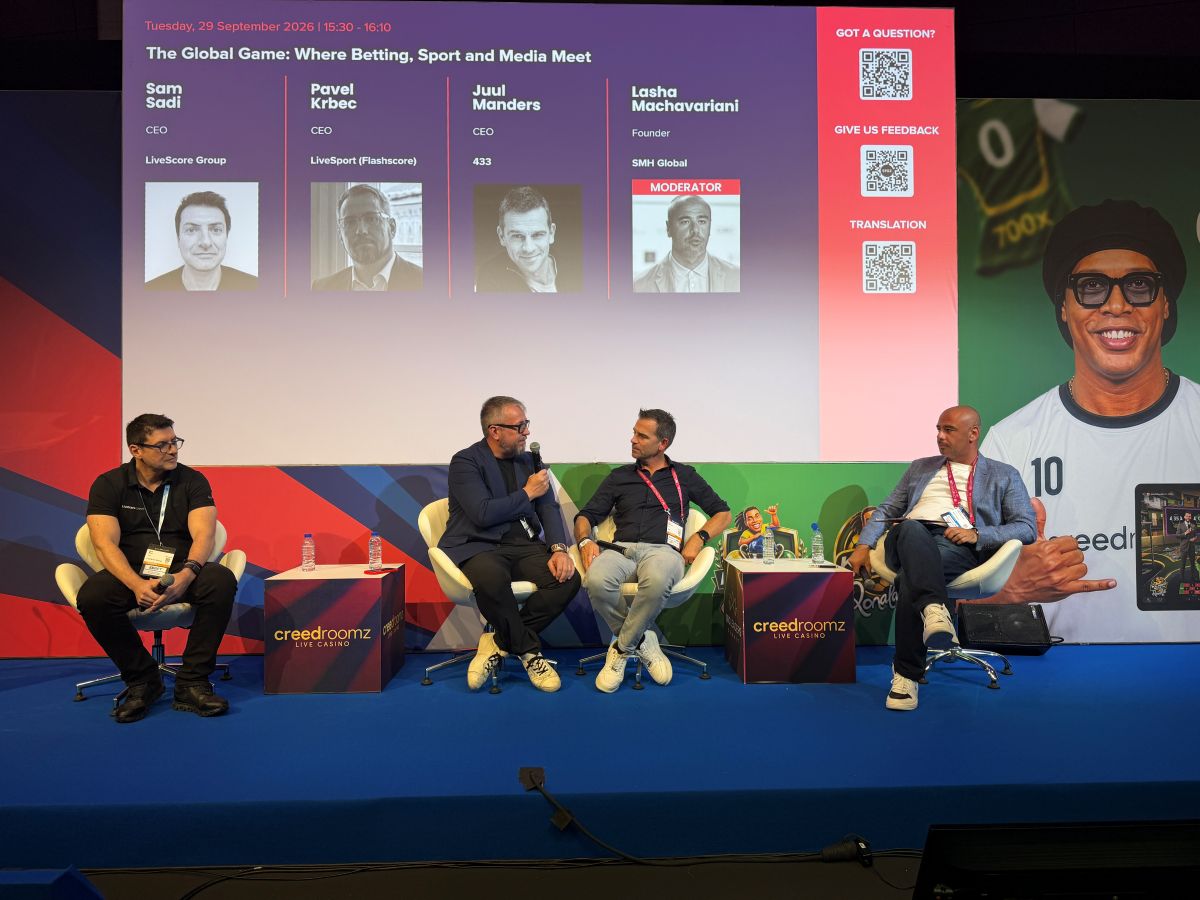
Sports media platforms can deliver vast audiences to betting operators, but turning that reach into a lasting business requires more than visibility. Trust, product quality and the ability to keep fans coming back were central themes at SBC Summit Lisbon 2026’s “The Global Game: Where Betting, Sport and Media Meet” panel.
Moderated by Lasha Machavariani, founder of SMH Global, the discussion brought together Juul Manders, founder and CEO of 433; Sam Sadi, CEO of LiveScore Group; and Pavel Krbec, CEO of Livesport Media (Flashscore). Their businesses sit at different points at the intersection of sport, content, and betting – and their views on its future were not always aligned.
An audience is not a sportsbook strategy
For LiveScore Group, combining sports media with betting has meant starting with the betting product rather than assuming an established audience would guarantee success.
Sadi challenged the logic behind media companies launching sportsbooks simply because operators spend heavily on advertising across their platforms. Betting, he argued, is a complex business that cannot be built on brand recognition alone.
“You need to be … an amazing sportsbook operator, and then you can aspire to bring a media component into your ecosystem,” he said.
He explained that LiveScore Group’s approach was to build a competitive sportsbook and bring sports media into that ecosystem, not to treat betting as an extension of an existing media business.
“People think any sportsbook that is integrated into media will succeed because of brand affinity or the exposure to the traffic,” Sadi said, warning against underestimating the operational expertise required.
Building a community – and keeping it
Manders traced 433’s origins to 2014, when the company identified football’s potential on social media. Its ambition was to create “the largest locker room in the world” – a global football community without a stadium or ownership of football rights.
According to Manders, that community now exceeds 600 million young football fans, while its content generated 28 billion views during the World Cup.
Maintaining that reach, however, requires constant adjustment. Platform algorithms, content formats, and audience habits all change, so yesterday’s successful approach doesn’t guarantee tomorrow’s performance.
“Today, a follower is less important, in my opinion, than it was before,” he said.
Manders compared the demands of content production to elite sport: teams must deliver speed, quality and volume consistently, particularly during major tournaments.
“One bad post can kill your day, can ruin your day,” he said. “You have to keep up, keep performing.”
That emphasis on sustained engagement resonated with Krbec, who distinguished between buying an audience and earning its repeated attention.
“Traffic you can always buy. Frequency you have to earn,” he said.
For platforms such as Flashscore and LiveScore, he argued, the commercial advantage is not simply sending a user to an operator once. It is maintaining a relationship with fans who return repeatedly for sports information.
Is broadcasting losing its hold on fans?
The panel’s sharpest disagreement concerned the future of sports broadcasting.
Sadi argued that rights-dependent platforms face a fundamental loyalty problem: viewers follow their teams and competitions, not necessarily the service showing them.
“There’s no loyalty to a broadcaster,” he said. “They’re loyal to their teams, to their leagues.”
Manders questioned whether the traditional subscription model can keep pace with younger audiences’ habits, particularly as rights costs rise.
“I think the broadcasters … have to reinvent themselves really fast,” he said.
Krbec pushed back against the suggestion that broadcasting is a dying business. Instead, he described an increasingly fragmented viewing experience in which live broadcasts and sports information platforms serve different needs.
“They do not watch one game. They watch five games,” he said of younger fans. “The first game is with the broadcaster … but the other four games are being watched at Flashscore in parallel on the second screen.”
In his view, Flashscore complements the broadcaster by delivering a service that a single-match broadcast cannot provide.
Sadi also cautioned against treating shorter attention spans as exclusively a generational issue. “Our brains are being rewired constantly because of how we consume media,” he said. “If you’re not willing to make those adjustments to this way of consuming, you’re gonna lose your audience.”
Betting revenue and the regulatory question
The discussion also examined how closely sports media’s commercial model is tied to betting.
Manders estimated that betting accounted for around 20% of 433’s sponsorship revenue at the time of the panel and said he expected its contribution to grow substantially. Krbec indicated that betting represented more than half of Flashscore’s commercial mix in the context of the discussion, adding that the company’s research suggested three-quarters of its users were involved in sports betting in some way.
Machavariani questioned whether regulators sufficiently consider the impact advertising restrictions can have on sports media – not just on operators. Reduced funding, he argued, can ultimately affect the service available to fans.
Sadi said sports media companies have generally been reluctant to participate in those policy debates. “They’ve usually chosen to remain on the sidelines because of the sensitive nature of betting.”
Krbec added that the distinction between betting advertising and sports information is not always straightforward from a user’s perspective. According to Flashscore’s research, users often regard odds alongside match details as information about the likely outcome rather than simply an advertisement.
“The odds are not only for bettors,” he said.
The programme doesn’t end here: days two and three of SBC Summit Lisbon are still to come, bringing the industry together for more insightful discussions, valuable connections and new opportunities.
Don’t forget to subscribe to our Telegram channel!